Businesses worldwide have long sought to gain a competitive edge and make smarter decisions through data-driven insights. With the rapid rise of Artificial Intelligence (AI), entire industries are transforming at an unprecedented pace. However, to unpick the success of AI in the modern era, you must look beyond the powerful algorithms to the data pipelines that feed them. These data pipelines enable the efficient collection, transformation, and movement of raw data into artificial intelligence (AI) and machine learning (ML) models, ensuring AI-driven insights are accurate, scalable, and timely.
In this article, we’ll explore the importance of Artificial Intelligence pipelines and how businesses can optimize them for maximum efficiency.
Key Takeaways:
AI data pipelines enable efficient decision-making: By automating the collection, processing and delivery of data, AI data pipelines allow businesses to make faster, better-informed decisions based on accurate, real-time insights.
Optimization drives accuracy, scalability and ROI: AI data pipelines help businesses improve model accuracy, speed up data processing, and ensure scalability to handle growing data volumes. This also increases return on investment (ROI) by automating processes and reducing errors.
AI enhances data movement and transformation: Incorporating AI within data pipelines improves how data is handled, enabling predictive analytics, sentiment analysis and more insightful decision-making processes, like forecasting future sales or understanding customer sentiment.
Data quality and infrastructure are crucial for success: To build a successful AI data pipeline, businesses must focus on data quality (through cleansing and validation) and robust infrastructure (like cloud-based storage or distributed computing) to support large-scale, real-time processing.
What is an AI data pipeline?
Put simply, an AI data pipeline is a specific sequence of processes through which data is collected, processed and transformed into a usable form for ML and AI applications. These pipelines automate the movement of data from its source to its destination, ensuring AI models receive high-quality data, either in real-time or batch form, enabling accurate analysis and decision-making.
An AI data pipeline consists of key components - data ingestion, processing, storage, model training, prompt engineering and deployment - that work together to provide AI models with clean, structured data, essential for accurate and actionable insights.
In essence, an AI data pipeline is the way an AI model is fed, delivering the right data, at the right time, in the right format to power intelligent decision making.
David LipowitzSenior Director, Sales Engineering| Matillion
AI pipelines play a critical role in ensuring businesses can harness the full potential of artificial intelligence. Through the seamless automation of data collection, processing, storage and delivery, these data pipelines ensure AI models receive high-quality data, enabling them to be accurate and efficient whilst informing decision-making.
Driving Efficient AI Decision Making
Through streamlined data collection, preparation and integration, AI data pipelines can eliminate manual processes to ensure AI models receive reliable and structured data. Access to timely and accurate insights enables businesses to make faster, better-informed decisions, thereby optimizing their operations.
Enhancing Accuracy, Speed and Scalability
Real-time and near real-time data processing is enhanced via the use of artificial intelligence pipelines, this is essential for applications such as fraud detection, predictive maintenance and personalized recommendations. By automating the cleansing and transformation of data, these data pipelines improve the accuracy and relevance of AI-driven insights.
They also enable scalability, efficiently managing large volumes of both structured and unstructured data as business needs evolve.
Increasing Automation, Reliability and ROI
By reducing human intervention, AI data pipelines can minimize errors, standardize data quality, and enhance reliability. A well-structured pipeline optimizes resource allocation, thereby lowering operational costs, and accelerating time to value, which maximizes return on investment (ROI) from AI initiatives.
With AI models supported by effective artificial intelligence data pipelines, businesses can future-proof their AI capabilities. This ensures that the insights gained through these models remain precise, actionable, and crucially, scalable, as the complexity and volume of data continue to grow.
AI’s Value in Data Pipelines
While AI data pipelines themselves are crucial, the true business value often comes from how AI is integrated within these pipelines. Matillion’s work in incorporating AI into data movement and transformation processes enhances the data pipeline experience.
Common data pipelines
First, consider a common use case as depicted below. Here we see the various data silos belonging to a hypothetical company called GreenWave Technologies, a sustainable agriculture tech company specializing in innovative farming solutions. The data sources they’re interested in include:
CRM data in Salesforce,
Customer 360 data in a file extracted from its source system, as well as
Point-of-Sale data stored in a PostgreSQL database.
Pipeline to integrate data silos
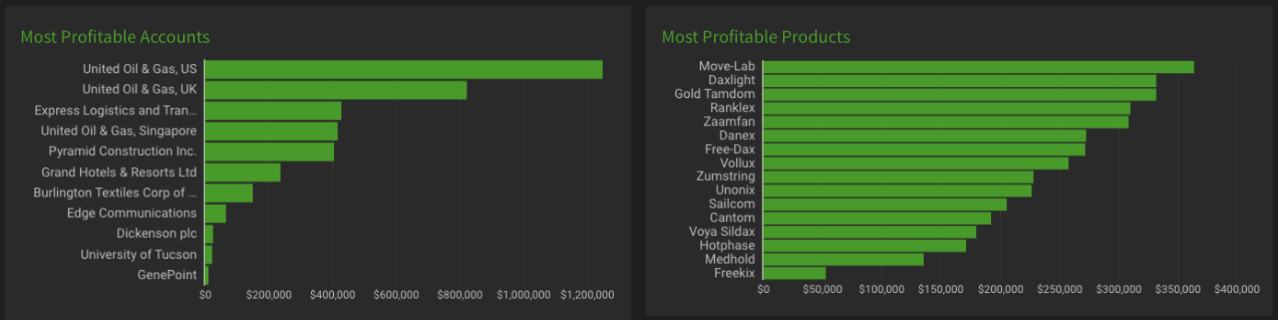
This pipeline extracts data from those sources, loads the results into Snowflake, and then runs the transformations necessary to make that data business-ready. At the highest level, these transformations cleanse, unify, and aggregate the extracted data, preparing it for visualization and giving GreenWave employees, from analysts to executives, the ability to garner insights from the results. In this case, information from each data source is needed to generate executive dashboards summarizing basic sales performance metrics like customer or product profitability.
Dashboards based on transformed and integrated data
Predictive analytics with Machine Learning
So far, so good. We’ve used a backward-looking data integration process to understand how GreenWave’s business is doing. Yet the descriptive statistics discussed above don’t provide a predictive analysis. We can do better by incorporating Machine Learning (ML). Below we see a company-wide measurement of sales performance in the form of Total Monthly Profit. And yet, with an incomplete month represented in the last data point, GreenWave as a company may be left wondering where the month will end up. Enter the forecast generated by machine learning algorithms, which executes as part of our data pipeline. Matillion can do this in a number of different ways, namely using our native Python execution capabilities or by leveraging Snowflake’s Cortex ML functions.
Using either method, these ML capabilities predict where this and future reporting periods will end up. The dashed line below represents the prediction which is created and refreshed as the last step in our data pipeline’s execution. The value of executing the machine learning step as part of the overall data pipeline is to ensure the prediction algorithm is working with the latest data. This gives the business the earliest possible warning of a problematic sales outcome and provides as much time as possible to intervene.
Profit chart enhanced by ML predictions
Sentiment analysis in data pipelines
Machine learning has been around for a number of years so let’s turn the discussion now to the application of the latest in generative AI (GenAI) technology: the Large Language Model (LLM). Below we’ll see how LLMs can be incorporated into a data pipeline. In fact, those pipelines are still necessary to prepare the data we want to use in our LLM use case. The Sales Performance data discussed above describes GreenWave’s previous performance and forecasts future performance. The pipeline below integrates a sentiment analysis with those insights.
Data Pipeline Incorporating Sentiment Analysis
Here we have an Excel file filled with roughly one thousand customer reviews of GreenWave’s products. These reviews run the gamut from very negative to very positive. For example, consider the two (fabricated) reviews below:
Positive Review Example:
I absolutely love using GreenWave Technology's Voya Sildax Crop Rotation Planning Software! It has revolutionized how I approach my farming practices, allowing me to improve soil health, prevent diseases, and optimize crop yields effortlessly. This software is an invaluable tool for any farmer looking to implement sustainable and efficient crop rotation schedules.
Negative Review Example:
This Move-Lab Precision Farming Drone from GreenWave Technology was an absolute disappointment. Despite its promises of advanced imaging and mapping technology, the drone failed to accurately analyze crop health or identify pest infestations. The precision touted in the product description was nowhere to be found as the data and field conditions provided were extremely inaccurate. Overall, a waste of time and money for any farmer looking to improve their crop yields.
The above is an example of unstructured textual data containing actionable but untapped business value. Matillion’s OpenAI Prompt component provides the key to unlocking this value. First, by loading these reviews into Snowflake, the data pipeline can then be pointed at those results and OpenAI can categorize the sentiment in these reviews. Here’s the prompt used to gather these insights:
You're a marketing analyst reviewing user product reviews from GreenWave Technology, a leading sustainable agriculture tech company that specializes in developing innovative solutions to promote sustainable farming practices. Based on the sentiment of the Product Review, characterize the Product Review as "Negative", "Mixed", or "Positive".
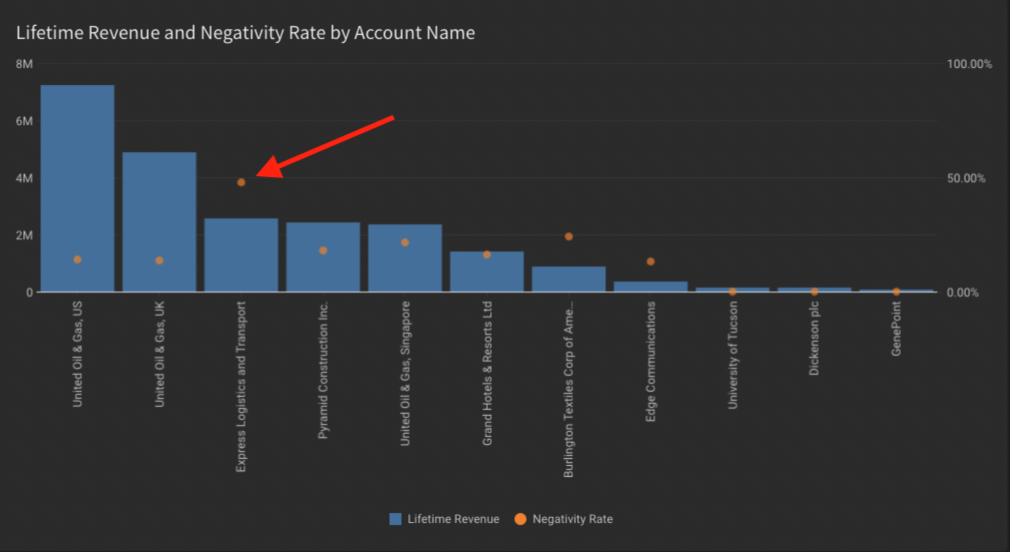
With those sentiments identified and loaded into Snowflake, we can then apply data transformations to associate the frequency of negative opinions with the Sales performance data we’ve already generated. Here’s an example of the insights this might produce:
Merging insights obtained from sentiment analysis
The visualization above identifies an outlier account with a substantially higher amount of negative sentiment. Further, we can see that this negative sentiment is clustered within GreenWave’s third largest and most important customer, Express Logistics and Transport. This gives GreenWave the ability to target its Customer Success activities where they will move the needle the most, namely by proactively aligning product experts with Express customers.
So by leveraging sentiment analysis within our data pipelines and by integrating Artificial Intelligence with Business Intelligence, GreenWave generated actionable insights with tangible business impact. And they did so more quickly, affordably, and reliably than any manual process would allow.
Limitless possibilities
Forecasting through and sentiment analysis like the examples above are only the beginning. Summarization, classification, and scoring use cases abound, among many others. Integrating machine learning and generative AI into data pipelines offers businesses unprecedented opportunities to enhance their analytics processes and drive value.
By incorporating machine learning algorithms, such as predictive forecasting, and leveraging LLMs for sentiment analysis, companies can uncover actionable insights from previously untapped sources of data. The case of GreenWave Technologies illustrates how AI augments existing data integration processes, enabling businesses to not only understand past and present sales performance but also anticipate future trends and include customer sentiments within their business strategies.
If you’d like to see more Matillion’s AI capabilities in action and how they can be incorporated in your business, sign up for a demo.
AI pipeline architecture is designed to process various types of raw data; however, each comes with its own unique set of characteristics and processing requirements. The design and functionality of the pipeline are typically dictated by the nature of the data, to ensure the efficient and accurate handling of the information.
Structured Data
Structured data is well-organized and typically found in relational databases or spreadsheets. It follows a defined format, with rows, columns and specific data types (e.g., integers, dates), making it easy to process as it fits a predictable schema.
AI data pipelines for structured data focus on efficiently querying, transforming, and loading it into analytics platforms or AI models. It is widely used in business intelligence, financial reporting and predictive analytics.
Unstructured Data
Unstructured data doesn't have a predefined format or organization, which makes it more challenging to process. It includes things like text documents, social media posts, images, videos and audio files. Because it doesn’t fit into traditional databases, analyzing it can be more difficult.
To make unstructured data useful for AI applications like natural language processing (NLP) or computer vision, AI data pipelines often need to carry out extra tasks, such as text mining, sentiment analysis, or image recognition. These processes help to extract valuable insights from raw data, enabling AI systems to understand and respond to more complex information.
Streaming Data
Streaming data is generated continuously, often in real-time, from sources like IoT devices, financial transactions, or weblogs. This type of data is time-sensitive and needs to be processed instantly, rather than in batches. AI data pipelines for streaming data are built to manage this fast-paced flow of information.
Streaming data is essential for real-time analytics and decision-making, allowing businesses to take immediate action based on events like system failures, user interactions, or stock price changes. These pipelines typically use real-time processing frameworks to ensure low latency and high-throughput performance.
Semi-Structured Data
Semi-structured data is a hybrid type that doesn’t fit neatly into traditional structured formats but still contains some organizational elements, like tags or metadata. Examples include JSON, XML, and NoSQL databases. While not as strictly organized as structured data, semi-structured data is easier to parse and process than fully unstructured data.
For AI data pipelines, semi-structured data often needs to be transformed before it can be fully utilized for machine learning models or analytics. These pipelines must handle different schemas and ensure the data is properly structured for further processing.
Whether it’s structured, unstructured, streaming, or semi-structured, each data type presents unique challenges and requires tailored processing strategies to ensure efficient and effective use. By understanding the characteristics of each data type, businesses can design and integrate pipelines that optimize data handling, enabling successful AI applications across various industries.
The Lifecycle of an AI Data Pipeline
AI data pipelines follow a structured lifecycle to ensure that raw data is effectively processed, transformed and utilized in AI applications. Each phase plays a critical role in maintaining data integrity, optimizing model performance, and enabling accurate predictions.
Data Collection and Preprocessing
The first step in an AI data pipeline is data collection, where raw data is gathered from various sources such as databases, APIs, IoT devices and user interactions. Preprocessing follows, involving cleaning, normalization and transformation to ensure data consistency and accuracy.
Model Optimization
Once preprocessed, data is fed into machine learning models for training. This phase includes feature selection, hyperparameter tuning and validation to optimize performance and prevent overfitting.
Inference and Deployment of AI Models
After training, the model is deployed for inference, meaning it processes new data to generate predictions or insights. Deployment may involve integrating with applications, real-time monitoring, and continuous updates based on new data.
AI Data Pipelines and Storage
Effective storage solutions are essential for AI data pipelines, ensuring that data remains accessible, secure, and scalable. Choosing the right storage option depends on data volume, performance requirements and compliance considerations.
Storage Solutions: Cloud vs. On-Premises
Data storage is a crucial element of AI data pipelines. Cloud-based storage solutions offer scalability, ease of access, and integration with AI platforms, while on-premises storage provides greater control and security for sensitive data.
Scalability and Reliability
Storage solutions must scale to handle growing data volumes and ensure high availability. Automated backups, data replication and distributed storage systems help maintain reliability and efficiency.
Building and maintaining AI data pipelines comes with challenges that can affect model accuracy, security and efficiency. Identifying and addressing these issues early is key to long-term success.
Data Quality Issues
Poor-quality data can lead to biased or inaccurate results from AI and ML processing. Implementing data validation, cleansing and augmentation techniques can mitigate these issues.
Model Drift
AI models can degrade over time due to changes in data patterns. Continuous monitoring and retraining ensure long-term model accuracy.
Security Concerns
Protecting data from breaches and cyber threats requires robust encryption, access controls and regular security audits.
Infrastructure Limitations
Scaling AI data pipelines can be challenging. Cloud-based architectures, distributed computing and automation tools can help optimize performance and reduce costs.
How to Build an AI Data Pipeline
Designing and implementing an AI data pipeline involves several key stages, ensuring the smooth flow of data from ingestion to model deployment.
Data Collection & Ingestion
Data ingestion is the first step in any AI pipeline. It involves gathering data from structured databases, APIs, IoT sensors, web scraping, and various other sources. Automating this process ensures consistency and reliability in data acquisition.
Preprocessing & Transformation
Once collected, the data must be cleaned and formatted. Preprocessing includes handling missing values, normalization, deduplication, and structuring data for model training. Feature engineering is often performed to enhance the quality of data used by AI models.
Model Training & Evaluation
In this phase, ML algorithms are trained using the processed data. Model evaluation is conducted through cross-validation, performance metrics (such as accuracy and precision), and fine-tuning techniques to optimize efficiency.
Deployment & Monitoring
After training, the model is deployed into production. This step involves integrating the AI model into business applications, setting up monitoring tools to track model performance, and implementing automated retraining when necessary.
Optimizing AI data pipelines involves enhancing efficiency, reducing costs, and ensuring scalability. Implementing best practices and performance techniques can significantly improve overall pipeline effectiveness.
Best Practices for Efficiency and Scalability
Automate data ingestion and transformation
Implement real-time processing where applicable
Use cloud-based storage for scalability
Monitor pipeline performance with AI-driven analytics
Performance Techniques
Parallel processing for faster computation
AI-driven automation for dynamic data handling
Cost-effective strategies for resource allocation
Real-World Examples of AI Data Pipelines: EPOCH Senior Living
EPOCH Senior Living, operating 16 communities across New England and New York, faced challenges with data silos and inefficient reporting processes. To address these issues, they collaborated with Amplify, a Sparq Company, to implement a comprehensive data integration solution. This initiative involved building multiple data pipelines utilizing Snowflake as the cloud data warehouse, Matillion's Data Productivity Cloud for ELT (Extract, Load, Transform) processes, and Power BI for visual reporting.
By integrating data from various sources - including ADP for payroll, Hireology for job postings, OnShift for workforce management and Yardi for financial reporting - EPOCH achieved a unified view of its operations. This consolidation eliminated data silos, enabling near real-time reporting and enhancing operational efficiency. The streamlined data processes also improved marketing attribution and facilitated better decision-making across the organization.
This case exemplifies the transformative impact of well-structured AI data pipelines in the senior living industry, showcasing how strategic data integration can lead to significant improvements in operational performance and service delivery.
To further explore how AI data pipelines can transform your organization's data strategy and drive operational efficiency, booking a demo. The Data Productivity Cloud offers robust solutions for building and optimizing AI data pipelines, as demonstrated in the EPOCH Senior Living case study.
Discover how Matillion's platform can help you streamline data integration, enhance decision-making, and unlock the full potential of your data.





Share: